


CNC milling & CNC turning from a single source
CNC machining:
Reliable manufacturing of precision parts
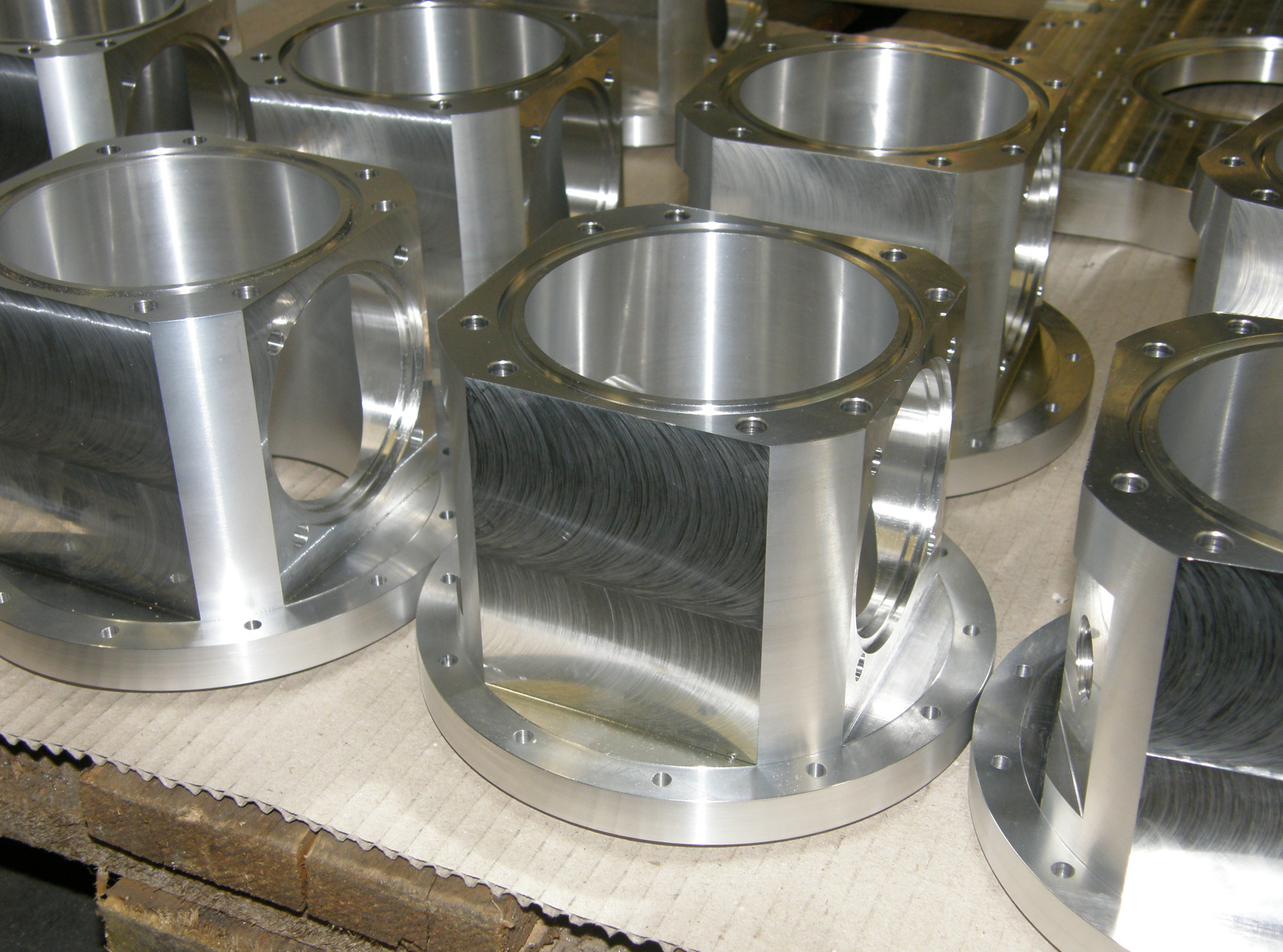
Using state-of-the-art CNC machining, we manufacture components economically, with high repeatability and on schedule, tailored to your series and individual part requirements. Precise milling and turning produce perfectly fitting components that reduce scrap and measurably increase your productivity. Our manufacturing processes are designed for maximum precision, ensuring that critical tolerances are consistently maintained even with high production volumes. Digital process monitoring and documented quality data create transparency and support Industry 4.0–compliant decisions in production. Short setup times, optimized tooling strategies, and standardized processes increase efficiency and sustainably reduce your part costs. We reliably implement complex geometries using CNC milling, including process-reliable clamping and inspection structures.
In CNC turning, we achieve functionally relevant surface finishes and dimensional accuracy, minimizing assembly effort and reducing the risk of failure. Continuous process optimization, from material flow to final inspection, ensures stable delivery and predictable capacity. Clearly defined inspection criteria and reproducible parameters guarantee consistent quality throughout the entire product lifecycle. Engineering-integrated manufacturing and short communication channels accelerate change management and future-proof your CNC machining. Whether prototype, small batch, or series production, we combine precision, process reliability, and Industry 4.0 approaches for dependable results.

An Overview of Our Services












Request a free consultation now – we'll provide you with practical advice.
Are you planning a new plant or would you like to automate an existing process? Whether it's special-purpose machinery, plant engineering, or targeted automation solutions: We develop a solution that fits your requirements, interfaces, and target values – transparently, structurally, and with a clear focus on cost-effectiveness.
Use the contact form for a non-binding inquiry. Briefly describe your task, and we will get back to you promptly to discuss how we can sustainably improve your production with a customized machine.


Your questions answered quickly
Here you will find answers to the most important questions.
What is meant by CNC machining of components and how does it work?
CNC machining of components is a subtractive manufacturing process. It is based on 3D models and derived technical drawings that define, for example, machining paths, spindle speeds, and feed rates. The result is precision parts with tight dimensional accuracy, ranging from simple geometries to complex contours, depending on the workpiece, tolerances, and process chain.
What are the advantages of CNC manufacturing?
CNC manufacturing impresses industrial customers with its high process reliability, repeatability, and predictable quality. Milling and turning processes reliably achieve tight tolerances, defined surface finishes, and complex shapes. This reduces scrap and simplifies scaling from prototypes to series production. Transparent costing is also important for purchasing managers: unit costs, delivery times, and inspection scope can be clearly defined, which is particularly relevant in contract manufacturing.
Which materials can be processed?
Many materials can be processed economically, typically metals and engineering plastics. Common materials include aluminum, steel, stainless steel, brass, and copper. The choice depends on the requirements for strength, corrosion resistance, and weight. Plastics such as POM, PA, PTFE, and PE are also possible. Key factors in manufacturing are machinability, heat generation, and the required surface finish.
For what production volumes is CNC manufacturing best suited?
CNC manufacturing is suitable for individual parts as well as small and medium-sized production runs, and in many cases even for larger quantities when flexibility is required. For prototypes and pre-production runs, CNC machining offers the advantage of rapid implementation without the need for expensive tooling. In series production, setup times, clamping concepts, and automated processes play a crucial role in reducing unit costs. Therefore, in CNC contract manufacturing, the optimal batch size depends on geometry, material, tolerances, and testing requirements. Important: A clean drawing and clear specifications expedite both the quotation and production processes.
Why is this method particularly suitable for mechanical engineering?
In mechanical engineering, components are often functionally demanding. Fits, bearings, and sealing surfaces must align reliably. CNC machining offers the necessary precision and reproducibility to manufacture precision parts according to drawings. Whether milling housings and plates or turning shafts, bushings, and bolts, these processes cover many typical mechanical engineering components. CNC manufacturing is also ideal when variants and modifications occur frequently, such as in special-purpose machines or retrofit projects. Defined processes, measurement strategies, and documented quality ensure the traceability that technical decision-makers expect.
The Team
Here you can find our team members.

Jens Collin
Management

Thomas Tepp
Operations Manager & Authorized Signatory

Kai Marquardt
Project Management

Michel Meinhardt
Design Management

Torben Schubert
Assembly Management

Andree Meißner
Quality Assurance

Arne Becker
Work Preparation

Robin Hordan
Production / CAM Specialist

Peter Hubrecht
Automation
Our process chain at a glance
Here you will find our process chain

Customer inquiry

Quotation Review & Cost Estimation

New orders

Work Planning (WP)

Manufacturing

Quality Assurance

Post-processing & Third-Party Services

Shipping & Logistics

Billing

Follow-up & Improvement